
Introduction
This massive tree will slowly reach a height and spread of 50 or more feet. Forest grown trees reach up to 120 feet. The tree is naturally low-branched with attractive glossy green leaves providing deep, inviting shade. Little grows in the dense shade of a Beech tree but if low branches are left on the tree no ground cover or grass is needed. In the fall, the leaves turn bronze but weather to a light tan color. Some leaves are held late into the winter if not blown off by the wind and the thin, smooth, silvery-gray bark is quite ornamental. The bark looks like elephant skin on older specimens. The four tiny nuts in each spiny bur of this American native are much prized by birds and various mammals, including man. The wood is almost white and is used most often in toys, cookware, furniture and for barrels which age beer. The tree is very resistant to decay under water so it was used to make water wheels in Colonial times. The wood is also used for tool handles, chairs, cuttings boards, and for making charcoal.
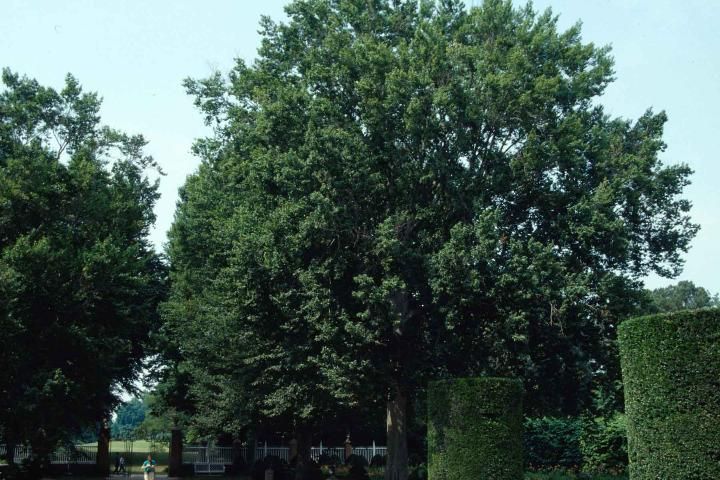
Credit: Ed Gilman
General Information
Scientific name: Fagus grandifolia
Pronunciation: FAY-gus gran-dih-FOLE-ee-uh
Common name(s): American Beech
Family: Fagaceae
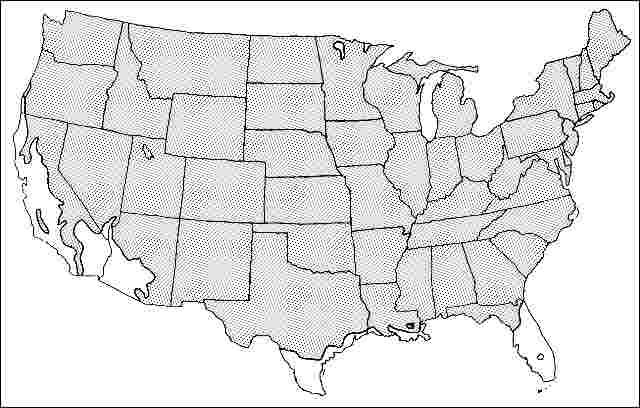
USDA hardiness zones: 3A through 8B (Fig. 2)
Origin: native to North America
Invasive potential: little invasive potential
Uses: hedge; shade; specimen
Availability: not native to North America
Description
Height: 50 to 75 feet
Spread: 40 to 60 feet
Crown uniformity: symmetrical
Crown shape: oval, pyramidal
Crown density: dense
Growth rate: moderate
Texture: medium
Foliage
Leaf arrangement: alternate (Fig. 3)
Leaf type: simple
Leaf margin: serrate
Leaf shape: ovate, oblong
Leaf venation: pinnate
Leaf type and persistence: deciduous
Leaf blade length: 2 to 4 inches
Leaf color: green
Fall color: copper, yellow
Fall characteristic: showy

Flower
Flower color: unknown
Flower characteristics: not showy
Fruit
Fruit shape: oval
Fruit length: .5 to 1 inch
Fruit covering: dry or hard
Fruit color: brown
Fruit characteristics: attracts birds; not showy; fruit/leaves not a litter problem
Trunk and Branches
Trunk/bark/branches: branches droop; very showy; typically one trunk; thorns
Pruning requirement: little required
Breakage: resistant
Current year twig color: gray, brown
Current year twig thickness: thin
Wood specific gravity: 0.64
Culture
Light requirement: full sun, partial sun or partial shade, shade tolerant
Soil tolerances: clay; sand; loam; acidic; well-drained
Drought tolerance: moderate, moderate
Aerosol salt tolerance: low
Other
Roots: can form large surface roots
Winter interest: yes
Outstanding tree: no
Ozone sensitivity: tolerant
Verticillium wilt susceptibility: resistant
Pest resistance: resistant to pests/diseases
Use and Management
Branch structure is typically very good, with one central trunk growing straight up through the crown of the tree. Many branches are often horizontally oriented, small in diameter, and well secured to the trunk.
American Beech needs a loose, acid soil which is well-drained yet can retain enough moisture for its shallow root system. The root zone should be free of compaction and grass competition. Not a good street or parking lot tree due to its need for good soil and low-branching, horizontal habit. Plant it on large estates along entry drives to large commercial properties or as a specimen in a park or campus setting. Young trees collected from the woods are difficult to transplant and are best simply preserved where they naturally occur, or should be planted from nursery-bought stock. Insect and disease problems are usually not very serious, but this is not an urban-tough, downtown type of tree. Give it plenty of above-ground and below-ground rooting space. It is not suited for dry climates.
Pests
Aphid colonies on the lower branches can be dislodged with a strong stream of water from the garden hose. Colonies are often disposed of by predatory insects.
Borers such as flat-headed appletree borer or two-lined chestnut borer bore into trees weakened by stress. Prevent the insect infestations by keeping trees healthy with regular fertilization and irrigation in dry weather.
Regular inspections of the trunk and branches are suggested for early detection of scales. Beech scale can be devastating to trees in the northeastern United States.
Certain caterpillars can be controlled with sprays of Bacillus thuringiensis . Insect identification allows proper spray recommendations to be made.
Diseases
Usually none are serious provided soil is not compacted and is well-drained.
Several fungi cause leaf spots but are generally not serious to warrant chemical control.
Powdery mildew causes a white coating on the leaves. The disease is most common late in the season.
Bleeding canker forms cankers from which a brownish liquid oozes. Crown symptoms include leaves of smaller size and lighter green color than normal. In severe cases the leaves wilt and the branches die. Avoid feeding with high nitrogen fertilizers as it seems to worsen the condition of infected trees.
Beech bark disease occurs when the feeding site of woolly Beech scale is invaded by a fungus. The fungus kills the bark and in the process, the insects. There are no satisfactory controls for the fungus. Control the disease by controlling the scale with a horticultural oil.
Cankers infect, girdle, and occasionally kill branches. Prune out the infected branches.
During periods of high temperatures and low rainfall Beech may scorch. Make sure trees are adequately watered and mulched.