
Introduction
A native American, usually single-trunked, evergreen tree, Loblolly-Bay reaches a height of 35 to 60 feet with a columnar or pyramidal, very open growth habit. The two to seven-inch-long, glossy, dark green leaves are a light grey color on the underside, giving a two-toned effect in the wind. Although evergreen, several individual leaves at a time will turn a brilliant scarlet color in the fall adding to its attractiveness. The white, two to three-inch-wide, five-petalled, cup-shaped flowers open from late spring through summer and are very attractive but sparsely produced throughout the canopy.

General Information
Scientific name: Gordonia lasianthus
Pronunciation: gor-DOE-nee-uh lay-zee-ANTH-us
Common name(s): Loblolly-Bay, Sweet-Bay
Family: Theaceae
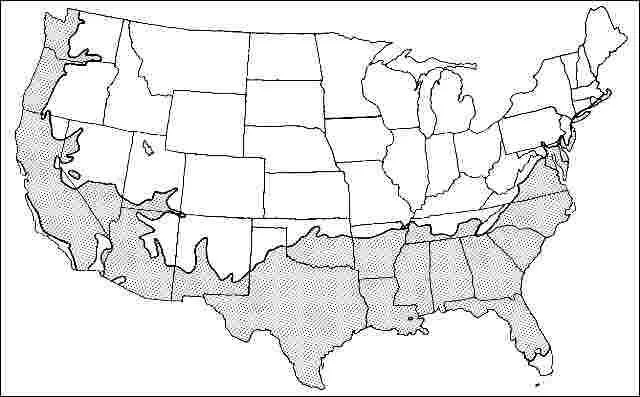
USDA hardiness zones: 7A through 9B (Fig. 2)
Origin: native to North America
Invasive potential: little invasive potential
Uses: specimen; espalier; reclamation
Availability: somewhat available, may have to go out of the region to find the tree
Description
Height: 35 to 60 feet
Spread: 10 to 15 feet
Crown uniformity: symmetrical
Crown shape: columnar
Crown density: open
Growth rate: moderate
Texture: medium
Foliage
Leaf arrangement: alternate (Fig. 3)
Leaf type: simple
Leaf margin: serrulate
Leaf shape: oblong, oblanceolate
Leaf venation: pinnate, reticulate, brachidodrome
Leaf type and persistence: evergreen, broadleaf evergreen
Leaf blade length: 4 to 8 inches
Leaf color: green
Fall color: red
Fall characteristic: not showy

Flower
Flower color: white/cream/gray
Flower characteristics: very showy
Fruit
Fruit shape: round
Fruit length: less than .5 inch
Fruit covering: fleshy
Fruit color: brown
Fruit characteristics: does not attract wildlife; not showy; fruit/leaves not a litter problem
Trunk and Branches
Trunk/bark/branches: branches don't droop; not showy; typically one trunk; thorns
Pruning requirement: little required
Breakage: resistant
Current year twig color: brown, green
Current year twig thickness: medium
Wood specific gravity: unknown
Culture
Light requirement: shade tolerant, full sun, partial sun or partial shade
Soil tolerances: clay; loam; acidic; extended flooding
Drought tolerance: moderate
Aerosol salt tolerance: none
Other
Roots: not a problem
Winter interest: no
Outstanding tree: yes
Ozone sensitivity: unknown
Verticillium wilt susceptibility: unknown
Use and Management
Loblolly-Bay makes an attractive specimen planting and its light, airy growth habit lends itself well to smaller, partially enclosed locations. In moist soils, Loblolly-Bay naturalizes well and is well-suited to the low-maintenance landscape. Due to the shape of the crown, it makes a suitable tree in urban areas with restricted, narrow overhead space, and should do well as a street tree, although it has not been extensively used yet.
Preferring partial shade and moist soil, Loblolly-Bay can tolerate full sun only with sufficient moisture. Loblolly-Bay has a shallow root system and will die if not watered during periods of drought. It is found in the wild most often growing in wet sites in the shade of maples, cypress and pines. It is well-suited for planting in boggy and other poorly drained soils. It is not salt-tolerant. Not for dry climates.
Propagation is by seeds which germinate well after stratification, or by cuttings.
The cultivar `Variegata' has white and green foliage, white flowers.
Pests
Pest problems are borers in weakened trees, aphids, and caterpillars.
Diseases
No diseases are of major concern.