
Introduction
A yellow carpet of fallen petals, delicate leaflets which cast a mosaic of welcoming shade year round, and large clusters of persistent rose-colored, papery capsules all help to make flamegold a very popular landscape tree. This broad-spreading, evergreen tree reaches a height of 35 to 45 feet and eventually takes on a flat-topped, somewhat irregular silhouette. It is often used as a patio, shade, street, or specimen tree. The small, fragrant, yellow flowers appear in very showy, dense, terminal panicles in early summer, and are followed in late summer or fall by large clusters of the two-inch-long "Chinese lanterns". These papery husks are held above the evergreen foliage and retain their pink color after drying and are very popular for use in everlasting flower arrangements. The bark is smooth and light brown when young, becoming ridged and furrowed as the tree matures. It is easily distinquished from Koelreuteria paniculata since Koelreuteria elegans has twice compound leaves, whereas Koelreuteria paniculata has single pinnate compound leaves; different from Koelreuteria bipinnata only in the fact that Koelreuteria elegans is evergreen.
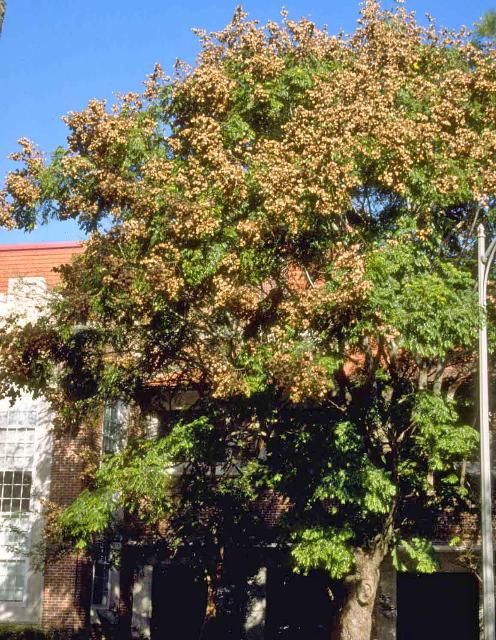
Credit: Ed Gilman, UF/IFAS
General Information
Scientific name: Koelreuteria elegans
Pronunciation: kole-roo-TEER-ee-uh ELL-eh-ganz
Common name(s): Flamegold
Family: Sapindaceae
USDA hardiness zones: 9B through 11 (Fig. 2)
Origin: not native to North America
Invasive potential: According to the UF/IFAS Assessment of the Status of Non-Native Plants in Florida's Natural Areas (Fox et al. 2005), Koelreuteria elegans (flamegold) may be used with caution in the central and southern zones of Florida, but should be managed to prevent its escape (counties are listed by zone at: https://assessment.ifas.ufl.edu/); and is not considered a problem species and may be used in north Florida.
Uses: parking lot island < 100 sq ft; parking lot island 100-200 sq ft; parking lot island > 200 sq ft; reclamation; urban tolerant; shade; specimen; street without sidewalk; tree lawn > 6 ft wide; tree lawn 4-6 feet wide; highway median
Availability: not native to North America

Description
Height: 25 to 50 feet
Spread: 35 to 50 feet
Crown uniformity: irregular
Crown shape: round
Crown density: open
Growth rate: fast
Texture: coarse
Foliage
Leaf arrangement: alternate (Fig. 3)
Leaf type: bipinnately compound
Leaf margin: incised, serrate
Leaf shape: ovate, oblong
Leaf venation: pinnate
Leaf type and persistence: deciduous
Leaf blade length: 2 to 4 inches
Leaf color: green
Fall color: yellow
Fall characteristic: not showy

Flower
Flower color: yellow
Flower characteristics: very showy
Fruit
Fruit shape: oval, elongated
Fruit length: 1 to 3 inches
Fruit covering: dry or hard
Fruit color: pink
Fruit characteristics: does not attract wildlife; showy; fruit/leaves not a litter problem
Trunk and Branches
Trunk/bark/branches: branches droop; not showy; typically one trunk; thorns
Pruning requirement: needed for strong structure
Breakage: susceptible to breakage
Current year twig color: brown
Current year twig thickness: very thick
Wood specific gravity: unknown
Culture
Light requirement: full sun
Soil tolerances: clay; sand; loam; alkaline; acidic; extended flooding; well-drained
Drought tolerance: high
Aerosol salt tolerance: moderate
Other
Roots: not a problem
Winter interest: yes
Outstanding tree: no
Ozone sensitivity: unknown
Verticillium wilt susceptibility: susceptible
Pest resistance: resistant to pests/diseases
Use and Management
Trees need to be trained when young to develop a strong branch structure. Spacing main branches apart along a central trunk is crucial to developing a durable tree. As soon as you see them, remove any double or multiple trunks which develop, especially if they have embedded or pinched bark in the branch crotch. Be sure to locate the first major branch high enough off the ground so that drooping leaves and branchlets will not get in the way of traffic below. Train major branches so they grow up and out, spreading from the trunk to create the clearance needed for street tree or parking lot planting.
The wood is fairly weak and branches can break in strong wind storms, but the tree definitely has a place in many landscapes. Planted in a full sun location, flamegold makes a moderately dense shade tree, but there is considerable variation among individuals of the species. Properly pruned and trained trees can be planted as street or parking lot trees, but do not commit large areas to this tree due to the possibility of them breaking up as they reach about 30 years old. They will be the source of many compliments when they are in flower and fruit. Dead wood periodically forms and must be removed to maintain a neat appearance.
Flamegold is a tough tree which should be grown in full sun on any well-drained soil, in sand or heavy clay, and should receive moderate watering. The tree becomes leggy and thin in partial shade. When well-established, Chinese flamegold tree will tolerate air pollution, heat, and drought. Tolerant of alkaline soil pH, it does well in many parts of the Deep South where soils are often calcareous.
Propagation is by seed, which will germinate within six to eight days.
Pests and Diseases
Scale, mushroom root rot on wet soil or on old trees. A canker causes dead and sunken areas on the bark. Coral pink fruiting bodies develop on the diseased bark. Prune out infected branches and fertilize to maintain tree health.
Verticillium wilt attacks Koelreuteria. The disease causes wilting and death of leaves on infected branches. Eventually the entire tree may be killed. Fertilize to stimulate growth. There are no chemical controls.