
Introduction
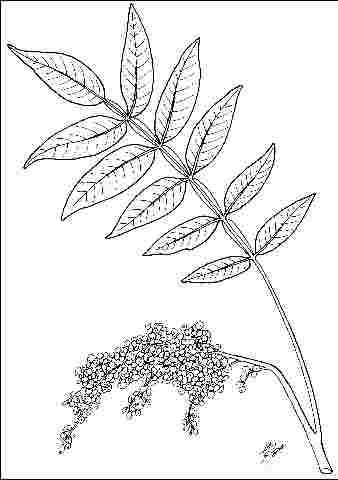
Winged sumac is well-suited to natural and informal landscapes where the underground runners spread to provide dense, shrubby cover for birds and wildlife. This species is the best of the sumacs for ornamental planting because of its lustrous dark green foliage which turns a brilliant orange-red in fall. The fall color display is frequently enjoyed along interstate highways, as the plant readily colonizes these and other disturbed sites. The tiny, greenish-yellow flowers, borne in compact, terminal panicles, are followed by showy red clusters of berries which persist into the winter and attract wildlife.

Credit: Ed Gilman, UF/IFAS
General Information
Scientific name: Rhus copallina
Pronunciation: roose kop-al-EYE-nuh
Common name(s): shining sumac, winged sumac
Family: Anacardiaceae
USDA hardiness zones: 5A through 10B (Fig. 2)
Origin: native to North America
Invasive potential: weedy native
Uses: specimen; reclamation; container or planter; highway median; urban tolerant
Availability: somewhat available, may have to go out of the region to find the tree

Description
Height: 12 to 18 feet
Spread: 12 to 18 feet
Crown uniformity: irregular
Crown shape: upright/erect, round
Crown density: moderate
Growth rate: moderate
Texture: medium
Foliage
Leaf arrangement: alternate (Fig. 3)
Leaf type: odd-pinnately compound
Leaf margin: entire
Leaf shape: ovate, oblong, elliptic (oval)
Leaf venation: pinnate
Leaf type and persistence: deciduous
Leaf blade length: 2 to 4 inches
Leaf color: green
Fall color: red, orange
Fall characteristic: showy

Flower
Flower color: yellow
Flower characteristics: showy
Fruit
Fruit shape: round
Fruit length: less than .5 inch
Fruit covering: fleshy
Fruit color: red
Fruit characteristics: attracts birds; showy; fruit/leaves not a litter problem
Trunk and Branches
Trunk/bark/branches: branches droop; not showy; typically multi-trunked; thorns
Pruning requirement: needed for strong structure
Breakage: resistant
Current year twig color: reddish, brown
Current year twig thickness: medium, thick
Wood specific gravity: unknown
Culture
Light requirement: full sun, partial sun, or partial shade
Soil tolerances: clay; sand; loam; acidic; slightly alkaline; well-drained
Drought tolerance: high
Aerosol salt tolerance: unknown
Other
Roots: not a problem
Winter interest: no
Outstanding tree: no
Ozone sensitivity: sensitive
Verticillium wilt susceptibility: susceptible
Pest resistance: free of serious pests and diseases
Use and Management
Winged sumac grows well on dry, sandy soils in full sun to part shade and requires little care. It is best used as a component of a shrub border, where its deciduous habit adds interest to an evergreen landscape. This makes a good roadside plant due to its drought tolerance and seasonal interest. It has not been widely used as a specimen or small tree but with some trianing and pruning makes a nice small tree located in a groundcover or near the deck or patio in a home landscape. Seasonal pruning would be needed to eliminate suckers and root sprouts.
Propagation is by division of the suckers.
Pests
No pests are of major concern.
Aphids suck plant juices. Aphids may be dislodged with a high pressure water spray from the garden hose.
Scales can usually be controlled with horticultural oil.
Diseases
No diseases are of major concern.
Several fungi cause cankers leading to dieback. Fertilize to keep plants healthy and prune out infected parts.
Fusarium wilt infects roots, causing the leaves to droop and wilt. A light infection causes only gradual dwarfing or yellowing and premature red leaf coloration.
A leaf spot causes gray spots with purplish margins that merge, giving the leaves a scorched appearance.
Various genera of powdery mildew-forming fungi form a white coating on the leaves.
Verticillium wilt causes wilting of individual stems, followed by death of the foliage. Eventually the entire plant dies. Prune out infected branches. Do not replant in the same spot with sumac or other susceptible plants.