
Introduction
Selecting the right tree for a particular place can avoid costly disappointment later. Trees adapted to the planting site are more likely to remain standing in hurricanes. Thorough site evaluation can ensure that the chosen tree will survive conditions inherent to the location.
Proper site evaluation, planning, and execution can result in a successful urban forest that resists hurricanes. Figure 1 shows a successful canopy street. Trees such as live oak trees can be chosen for their wind-resistant structure and ability to provide shade, but they were only able to thrive given the adequate open soil and growing space and distance from above-ground structures, such as streetlights and wires.

Photo Credit: Adobe Stock, Steve Lovegrove
A simple way to begin a site evaluation is to drive around town to find out which species grow well in landscapes with similar site attributes. It is important to keep in mind that no two sites are exactly alike; various conditions both above and below the ground affect the success of a particular tree species. Visiting a local public garden or nursery is also a great way to learn about all the different species that are available and grown locally. A wide variety of books and web materials can provide specific information about growing and selecting trees in the area.
Site Evaluation
Site evaluation is the first step in selecting proper trees for a planting site. It is important to consider both the above-ground and below-ground site attributes during this assessment. Many people skip the site evaluation process, which explains why trees planted in urban areas are so often short-lived.
Hardiness
Tree adaptations to regions of the country are designated by their hardiness zones. The hardiness zone map, developed by the United States Department of Agriculture, specifies the average lowest winter temperature expected for regions in North America. When choosing trees for a planting site, first note the hardiness zone number of the planting site on the hardiness map. Trees with a hardiness zone range that includes this number are best suited for the site.
Above-Ground Site Analysis
In the above-ground evaluation, many elements should be considered. Environmental factors such as light and slope exposure, wind, salt and existing tree presence should be considered, as well as urban conditions such as overhead wires, street and security lights, buildings, signs, vandalism and regulations.
Light Exposure
Note how many hours of direct sun the planting site receives in the summer. Remember to account for the seasonal change in the sun angle when evaluating sites in other seasons. Trees such as crape myrtle that require full sun need at least six hours of direct sun, though all-day sun produces the best form and growth. Trees suited for full sun to partial sun/partial shade will adapt to a site receiving three to six hours of direct sun. Trees that require some shade will adapt to sites receiving less than three hours of direct sun. Most large trees grow best in full sun. Sunlight reflected from glass or a wall on buildings can increase the heat load on a tree planted near a building.
Slope Exposure
Trees with thin bark (e.g., cherries, plums, maples) can transplant poorly on southern and western slopes. Transpiration and evaporation from the soil are enhanced on south and west slopes, making it more difficult to maintain adequate soil moisture. Because of this, plan on providing more irrigation to southern and western exposures to help prevent desiccation; drought-tolerant trees are best adapted to these exposures. Northern slopes are more protected from direct sun exposure, and soil there stays moist longer.
Drought-tolerant trees that grow in full sun are best suited for this kind of site. In addition, providing a large area of soil for roots to explore often helps trees withstand reflected light because the trees have access to more soil from which to absorb water. Irrigation helps these trees as well.
Wind
Wind increases the amount of water lost from a tree to the atmosphere. Therefore, in areas exposed to higher winds (e.g., near the water bodies), consider choosing only drought-tolerant trees. Otherwise, special provisions should be made to increase the availability of irrigation or to protect the site from direct wind. If the site has poorly drained soil, trees will need to be both wet and drought tolerant.
Salt
Airborne salt affects trees by burning back twigs and foliage, or through roots after it is deposited on the ground and penetrates the soil. Salt-tolerant trees are often deformed by direct exposure to salty air, but they survive and grow just fine. Foliage on salt-sensitive trees burns, and trees become deformed and grow poorly when exposed to salty air. Trees with one-sided canopies near the coast can be very susceptible to hurricane-force winds that impact the canopy from the heavy side, but this is unavoidable.
Other Trees
Young trees that tend to develop broad canopies, and that require full or at least partial sun (oaks, mahoganies, etc.) often bend toward the sunlight and develop a one-sided canopy when they are planted under a canopy of established trees. Trees planted between existing established trees may grow slowly or not at all in response to root competition and lack of water and shade.
Overhead Wires and Street/Security Lights
Look up before you plant. Trees are often planted too close to power lines and security lights. When branches reach wires, the utility company must prune them to ensure safe and reliable utility service. Unfortunately, this costs utility companies (and ultimately the customers) billions of dollars each year in the United States. Lower costs and minimize damage in hurricanes by planting only properly sized trees near wires (Table 1). It is best to plant trees as far away from wires as possible (Figure 2).
Table 1. Suggestions for planting trees within 40 feet of wires or street lights.
|
Distance from Wires or Light |
Tree Size at Maturity |
|---|---|
|
0–6 feet |
Planting is not recommended unless trees remain under 25 feet tall |
|
6–40 feet |
Height should be 10 feet or shorter than wire/light or canopy diameter should be less than twice the distance to wire/light |
|
more than 40 feet |
Any tree can be planted |
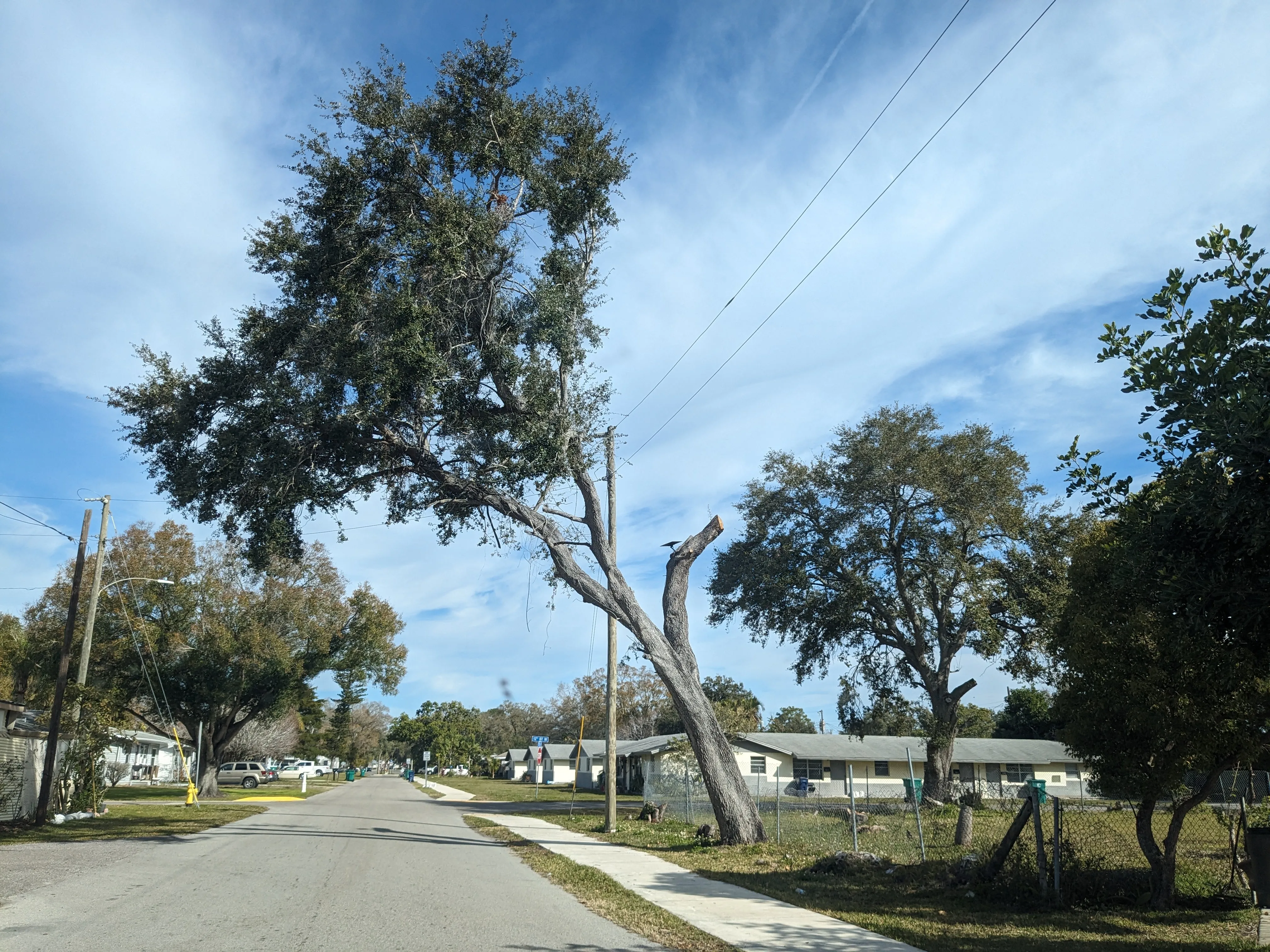
Photo Credit: UF/IFAS, Alyssa Vinson
Trees are often located in the same parking lot islands as overhead security lights. Eventually the tree canopy will grow into the structure, blocking the desired light. This requires regular pruning to clear the light, which results in a deformed canopy. Good planning locates trees and security lights away from each other, positions lights about 12 feet from the ground so the tree canopy can grow over the light or selects trees that remain small at maturity so that they remain under the light.
Buildings
Trees are most stable in the ground when they develop a uniform root system with straight roots distributed evenly around the tree. If a tree is close to a building, the root system can become one-sided and unbalanced. Unbalanced root systems result in tree failure in strong winds. A tree with a narrow canopy may be a good choice within 10 feet of a building, although tree canopies can adapt by growing more on the side away from the building. If shade is desired, consider planting several small-stature trees to create a closed canopy (Figure 3).

Photo Credit: Adobe Stock, evening_tao
Signs
Signs and trees frequently conflict with each other due to poor planning. To help prevent this, plant large trees near low signs and small trees near tall signs. Large-maturing trees could be in the way of a low sign for several years after planting, but if the tree is grown with a single trunk, lower limbs can be reduced and eventually removed, so the sign remains visible. Many communities have implemented a landscape code requiring signs to be no more than 8 – 10 feet from the ground, eliminating this potentially costly problem. The best ordinances place signs 3 – 4 feet from the ground.
Vandalism
People sometimes intentionally destroy or injure trees, or they may be unintentionally injured if they are planted in vulnerable sites such as sidewalk cutouts, where people walk close to the trees. If vandalism is a concern, consider not planting trees with thin bark (e.g., red maple), or choose trees at least 4 inches in trunk diameter.
Below-Ground Site Analysis
Important soil attributes that affect tree selection are pH, drainage, depth, salinity, distance to the water table, and obstacles to root growth such as curbs. Many plantings fail because these factors are improperly evaluated or ignored. Early evaluation will allow you to identify good soil and make provisions to remove and stockpile it. Good soil is precious and should not be wasted. It can be brought back to the site once construction is complete to promote tree growth. Pre-construction planning also gives you the opportunity to work with contractors to prevent excessive soil compaction in areas where trees will be preserved and planted. Isolate these areas from heavy equipment and other vehicles using sturdy fences.
Rooting Space Restrictions
Match ultimate tree size to the soil volume available for root growth. This strategy helps keep trees healthy and stable in storms. It also prevents damage to surrounding sidewalks, curbs and pavement (Figure 4). Soil under pavement is typically poorly aerated and compacted, a situation that is considered inhospitable for roots, unless soil is coarse sand and well drained. Roots will be mostly confined to soil space not covered by pavement or the space between the soil and bottom of the pavement. This will inhibit development of a strong root system and can result in the tree becoming unstable in hurricanes. Some wet-site-tolerant trees (e.g., baldcypress) are adapted to produce roots under pavement, and they can remain upright in strong winds.

Credit: Photo Adobe Stock, Loraine
Soil pH
Soil pH governs the availability of nutrients to plants and affects the activity of soil microorganisms. A pH test should be conducted in several areas of the site, wherever soil color or texture appears different. Site pH may vary too much to plant the same species across the entire landscape.
To collect samples for testing from an open area such as a lawn where soil may be uniform, dig about ten small holes five to ten feet apart with a trowel or shovel. Remove a slice of soil from the side of each hole from the surface down to 12 inches deep. You might choose to use a portable soil coring device to collect the samples if one is available. Mix soil together in a clean plastic bag or clean bucket or jar and take or mail a sub-sample (about a pint) to a lab to be tested.
Most trees can grow in soil with a pH between 4.8 and 7.2. If the soil is less than 4.8, select trees tolerant of acidic soils. If the soil is greater than 7.2, select trees tolerant of alkaline soils. Few trees grow well in soil with a pH above 9.0.
Compacted Soil, Poor Drainage, and Low Oxygen
Urban soils are often compacted and poorly drained; even sandy soil can compact. These soils contain little oxygen—a gas that tree roots need to survive and grow. Only species and cultivars tolerant of wet sites can survive in the difficult soils (e.g., baldcypress, sweetbay, pond apple, etc.). Use of trees with aggressive root systems (e.g., ficus and oak) should be considered carefully because large surface roots often form. These can disrupt lawn mowing operations and can damage curbs, sidewalks, pavement, and other nearby structures. Large shade trees often fall over in hurricane-force winds because inhospitable soil prevented their establishment of deep, stabilizing root systems. Plant small- to medium-sized trees (under 40 feet tall at maturity), for a more hurricane-resistant landscape.
To check for compaction and drainage, dig several holes at least 18 inches deep around the site. If soil is very difficult to dig with a shovel, it may be compacted. If soil is easy to dig into with a shovel, it is probably not compacted. Drainage can be determined by filling these holes with water (Figure 5).
If soil is very compacted and hard throughout the planting hole, then wet-site-tolerant trees are most appropriate. Expect many roots to develop at the surface. Ideally decrease compaction to loosen the soil. Occasionally, soil is loose underneath and compacted only on the surface. If you can break up the compacted layer on the surface for 15 feet or more around the tree before planting, drainage and tree growth may improve. In this case, trees can be chosen regardless of their wet-site tolerance.

Credit: Image UF/IFAS, Alyssa Vinson
Subsurface Compacted Layers
Soil loosely spread over compacted subsoil creates special challenges. Roots often grow only in the loose soil and will not penetrate the compacted subsoil. Small- to medium-sized trees are recommended if less than two feet of loose soil is spread over a compacted subsoil. This is because large-maturing trees could become unstable and high risk due to shallow root systems.
Soil Depth and Distance to the Water Table
If bedrock comes close to the surface or if there is little soil, plant only small- to medium-sized trees. Large-maturing trees in soil less than two feet deep could topple over in storms as they grow older because they lack deep roots. Roots on some trees can grow in solution holes in oolitic limestone to secure the tree firmly.
Dig several holes two to three feet deep, fill with water, and wait two to four hours if necessary. Any tree can be planted if no water appears in the hole. If water appears in the hole, select trees that tolerate wet sites. If the distance to the water table is less than 2 feet, plant small- to medium-sized trees. Possible exceptions are baldcypress and tupelos, especially if they are planted in groups.
Distance to the water table often varies during the year. It might be several inches below the surface in the cooler season and drop several feet in the growing season because transpiration pulls it from the soil. Special weather events can influence water table depth also. Sites with varying conditions should be considered poorly drained. To help avoid making erroneous conclusions about depth to the water table, determine depth during the coolest or wettest season. Consult local soil experts for this.
Underground Utilities
Do not plant a tree before determining where underground utilities are located. Consult local cable companies, water/sewer departments, electric utilities, and telephone and gas companies before digging. Many states have a hotline to call before digging, such as the Sunshine in Florida at 811 or directly (1-800-432-4770). Roots of large-maturing trees planted within ten feet of underground utility lines could be damaged when the utility is serviced. For this reason, some communities restrict planting near these utilities. Roots usually will not penetrate well-designed, properly installed utilities that do not leak water. Roots sometimes grow in the trench dug to hold the utility because it may be less compacted than surrounding soil.
Potential Site Modifications
Modifications made to the site can help accommodate a wider variety of tree species. When made before planting, site modifications such as moving wires or streetlights, grading, improving drainage, and incorporating soil amendments over broad areas can have an impact on soil conditions that will affect tree growth and species selection.
Moving Lights and Wires
Streetlights and overhead power lines can be moved or modified to make room for trees. Though this is not commonplace, it is surprising how often it’s done once the suggestion is made. In many instances, it is a more permanent solution to a design problem, allowing trees to be planted along a street in an area where they should not be planted without moving or modifying fixtures. Some communities design utility corridors that contain utilities within a specific area and allow trees to be planted away from the corridor without interference.
Changing Soil pH
It is better to plant trees adapted to the existing soil pH than to change soil pH. Applications of sulfur or limestone to soil usually provide only a temporary pH change. Regular applications must be maintained to adjust the pH levels. It is best to plant species that are tolerant of the pH at the site or replace the soil.
Improving Drainage and Reducing Runoff
Water running off a site can carry soil, pesticides, and fertilizers that contribute to environmental degradation. Soil is often graded (shaped) to keep as much water on the site as possible. To reduce runoff and sedimentation, redirected water should stay on site, rather than being channeled into streets or streams. Highway and other linear spaces surrounded by curbing can be designed to retain water if drainage is adequate.
Use a trencher to dig four or more trenches out from the planting hole, then loosely backfill with the soil from the trench. This provides channels for root growth in a compacted site, improves drainage a little, increases water percolation, and reduces runoff.
Other Soil Improvements
Some soil modification techniques can improve soil conditions for root growth. These include adding fill soil, replacing soil, and adding inorganic or organic matter over a large area. Modifying the small area in backfill soil adjacent to the root ball does little to benefit trees. Site design and modification are covered in detail in Urban Design for a Wind-Resistant Urban Forest.
Evaluate Maintenance Practices
Understanding how the site will be managed after planting is a critical factor in tree selection. Maintenance issues such as irrigation, pruning, fertilization, and pest control can affect whether a tree is able to thrive. For example, if the planner knows that trees will not receive any pruning once they are in the landscape, then a tree with a naturally good structure (e.g., excurrent growth habit) is preferred.
Irrigation
The ability to deliver irrigation determines which species and nursery stock sizes are best suited for the site. If trees can be irrigated regularly only until they are established, drought-tolerant trees should be chosen, and nursery stock of any size can be planted. If trees receive irrigation during establishment and then regularly during the life of the tree, or if you are planting in the plant’s native range and soil type, any tree regardless of drought tolerance can be planted (Table 2). If irrigation cannot be supplied for the period of time shown in Table 2, then plant smaller-sized nursery stock.
Table 2. Irrigation schedules depend on the size of nursery stock and desired objective. Establishment takes approximately 3 to 5 months per inch of trunk caliper.
|
Size of Nursery Stock |
Irrigation Schedule for Vigor |
Irrigation Schedule for Survival |
|---|---|---|
|
<2 inch caliper |
Daily: 2 weeks Every other day: 2 months Weekly: until established Daily: 1 month |
Twice weekly for 2-3 months |
|
2-4 inch caliper |
Every other day: 3 months Weekly: until established Daily: 6 weeks |
Twice weekly for 3-4 months |
|
>4 inch caliper |
Every other day: 5 months Weekly: until established |
Twice weekly for 4-5 months |
Pruning
Trees should be pruned regularly to maintain good health and longevity. An effective pruning program helps trees resist hurricane-force winds. An effective urban forestry program makes necessary pruning an integral part of the budget. These programs budget for structural pruning for the first 25 years after planting (see Chapter 12—Designing a Preventive Pruning Program in Your Community: Young Trees for details).
Unfortunately, tree-pruning budgets are often too low to allow pruning every 3 to 5 years following planting. If this is the case, consider planting those species that require only a moderate amount of pruning to develop and maintain good structure. This list can be found on the website listed at the end of the document. However, the saying you can pay me now or later is true with pruning, as pruning trees when young saves money compared to correcting poorly structured trees later.
If there will be infrequent or no pruning, or if no one knows when or how trees will be pruned, then do not plant large-maturing trees if there is a structure (e.g., streetlight) that may conflict with tree growth. For maximum wind firmness in hurricanes, it is best to plant hurricane-resistant trees (see Chapter 8—Selecting Southeastern Coastal Tree Species for Wind Resistance and Chapter 9—Selecting Tropical and Subtropical Tree Species for Wind Resistance), including those with a naturally good structure, such as magnolia or baldcypress.
Fertilization
Fertilization is mostly an issue in alkaline soils that cause micronutrient deficiencies. If a tree that is not tolerant of alkaline soil (e.g., queen palm) must be planted in a soil with alkaline pH for historic or other special reasons, then be prepared to conduct a regular monitoring and treatment program designed to prevent micronutrient deficiencies.
Cleanup
Trees with large fruit (royal poinciana), hard fruit (hickory or mahogany), or very fleshy fruit (fig, seagrape, cocoplum, or queen palm) can create a mess or trip hazard on sidewalks and pavement beneath the canopy. Pedestrians can slip and fall on the fruit, and it can be unsightly. If cleanup budgets are low, consider planting trees without this type of messy fruit, such as the fruitless `Rotundiloba’ cultivar of sweetgum, in areas with high pedestrian traffic. However, it is also important to keep in mind that many fruitless cultivars are male plants that can increase the amount of pollen in an urban area, potentially exacerbating air pollution issues. Ethephon sprays can halt fruit production with proper timing.
Choose Desirable Tree Attributes
Up to this point in the evaluation process, trees have been chosen primarily for their ability to grow at the site. While this is the most crucial criterion for tree selection, desired tree attributes such as function, size, form, and longevity are also important when choosing a species.
Function
Healthy trees provide us with many benefits. They give shade, produce oxygen, control erosion, protect our water resources, increase asphalt durability, support wildlife, and stabilize stream banks. The function we would like a tree to provide may dictate its size, shape (form), lifespan, canopy density, color, growth rate, fruit characteristics, and other attributes.
Mature Size
Large trees (>50 ft at mature height) are the obvious choice for providing shade to large open spaces and for planting along streets if there is proper space above- and below-ground. Medium or large trees will cast the most shade onto a building, which can reduce air conditioning bills when the trees are placed properly. Keep in mind, however, that larger trees are more likely to be damaged and cause damage than small trees. Prudent managers weigh the advantages and disadvantages of planting large-sized shade trees.
Small trees (<30 ft at mature height) are often suggested for planting in downtown areas where soil space is limited, but they provide little shade. Small- or medium-sized trees may be good choices for planting near a deck or patio, or in areas exposed to potential hurricane-force winds. Bear in mind, however, that the benefits small trees provide are small compared to large trees.
Form
Tree forms can have a big impact on tree maintenance requirements. There are many urban landscape situations that call for trees near the pavement. Small, spreading trees that are multi-trunked require regular pruning if they are planted too close to a sidewalk, whereas a small, upright tree or a larger tree can be trained to grow over the walk or street (Figure 6). Trees with a pyramidal form usually require less pruning to develop strong, wind-resistant branch structure than those with other forms. Trees with rounded, oval, or spreading canopies often need periodic pruning in the first 25 years after planting to ensure good structure and to provide clearance.
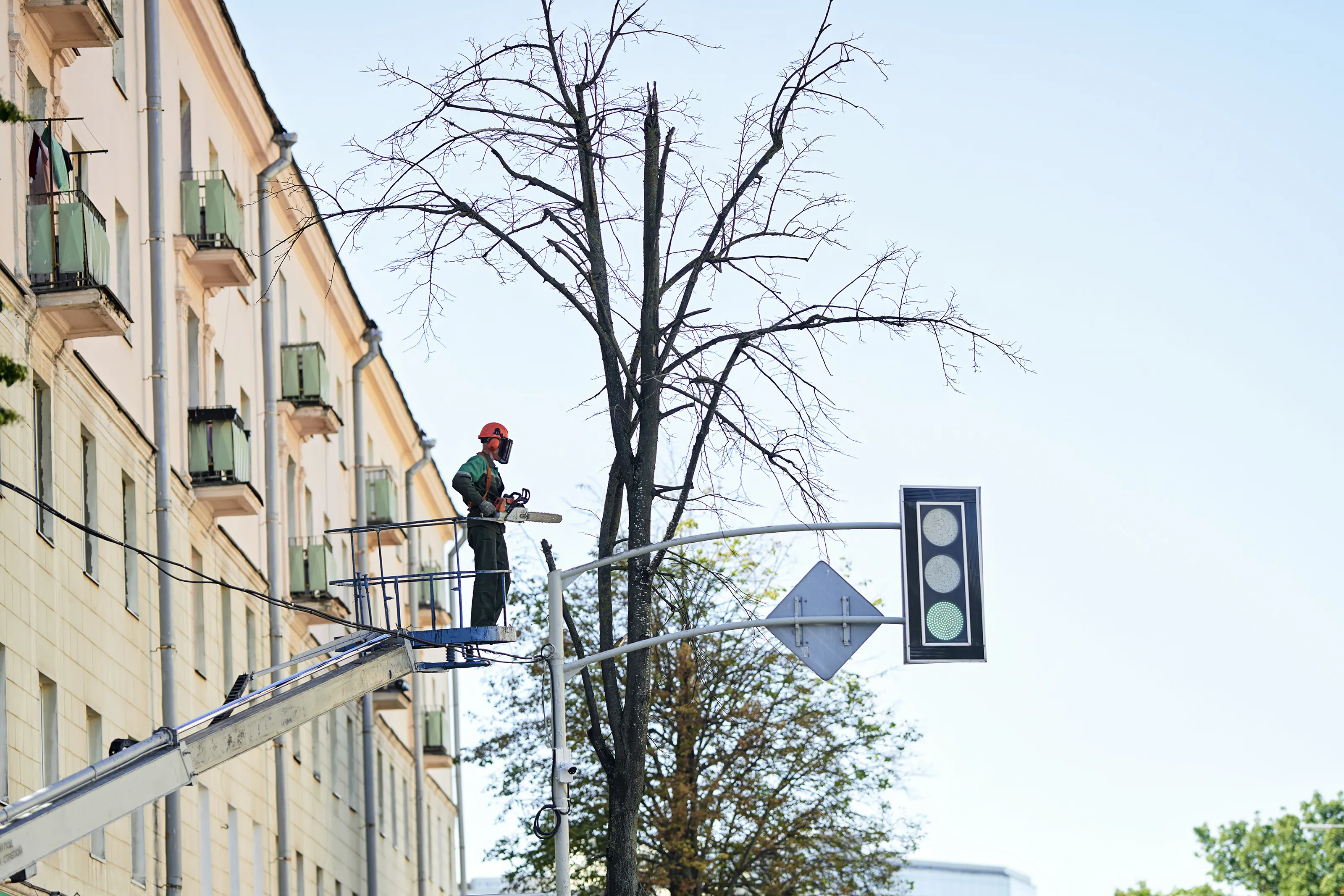
Photo Credit: Adobe Stock, Tricky Shark
Longevity
Large, long-lived trees might be the logical choice for planting in most landscape situations, since they would provide for a lasting effect. However, with reasonable placement and care, long-lived trees will probably outlast many of today’s streets, homes, and buildings. Many structures are renovated or expanded 30 to 50 years after construction. The renovation is often so extensive that it becomes difficult to provide the protection needed for a large, long-lived tree’s extensive root system to keep the tree alive. For this reason, concern about tree longevity may be less important in highly urbanized landscapes unless special provisions are undertaken to protect the tree.
Tree Selection
It is important to plant and maintain a diversity of tree species throughout the community. This helps spread the risk of damage in storms. It may require more work and creativity to find a variety of trees that can withstand urban conditions, but it is well worth the effort. Species diversity allows a landscape to withstand devastation by insect or disease outbreaks, and if executed appropriately can provide a more aesthetic appeal. However, species selection alone will not prevent danger in storms. Trees must be positioned and maintained appropriately to create hurricane-resilient urban forests.